Behar
The Seventh Year: Ownership with an Expiration Date
12.5.2026
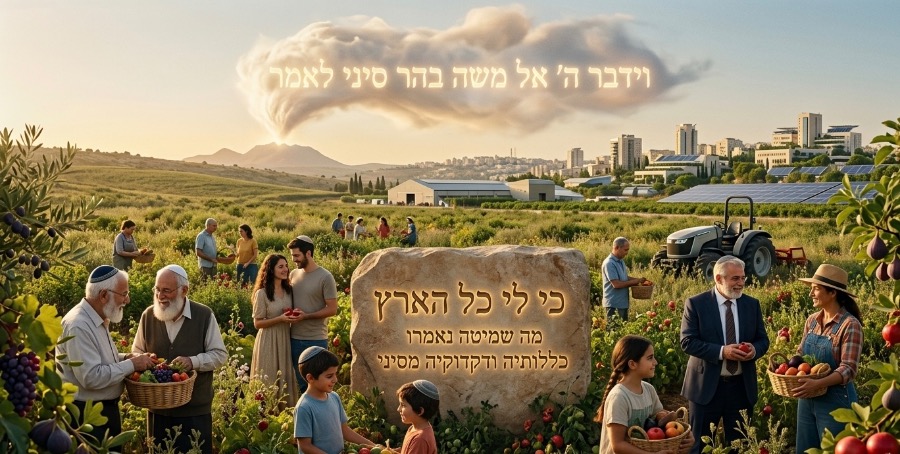
Parashat Behar opens with a strange sentence: “And G-d spoke to Moses on Mount Sinai, saying” (Vayikra 25:1). Rashi is famous for his question: “What is the matter of Shemittah at Mount Sinai?” Meaning, why does the Torah need to emphasize that this commandment was said specifically at Mount Sinai? After all, all the commandments were given at Sinai.
The answer that Rashi gives echoes far beyond the interpretive question:
“Just as the general principles and the details of Shemittah were said at Sinai, so too all of them were said with their general principles and their details at Sinai.”
Shemittah was chosen as the classic model of a commandment given in its full form from Mount Sinai. But why specifically Shemittah? What makes it a symbol?
When reading the parashah with the eyes of 2026, it is hard not to be amazed. Every six years a person works his land, sows, harvests, earns. Then the seventh year arrives and suddenly everything stops. It is forbidden to plow, forbidden to sow, forbidden to harvest for private use. The fruits of Shemittah are ownerless and belong to everyone: the poor, the rich, the stranger, even the animal.
This is not a simple law. It is a deep philosophical statement: the land is not yours.
Rabbeinu Bachya on Vayikra formulates it clearly:
“For this reason the Torah commanded this mitzvah, so that all forms of rule and ownership in the lower world are cancelled in the work of the land, so that a person will understand in his heart that true dominion and authority belong only to G-d, blessed is He.”
In simple words: once every seven years, even the richest landowner must admit clearly: this is not mine.
Here comes a philosophical question that has troubled thinkers from John Locke until today: what is the right of ownership?
Locke said that a person acquires ownership through his labor. If you mix your effort with something, it becomes yours. Jean-Jacques Rousseau went further and said that the idea of private property is the root of social evil.
The Torah gives a third, surprising answer: ownership exists, but it is always temporary. You are an owner for six years, and in the seventh year you are reminded of a deeper truth. In the Jubilee year, once every fifty years, all lands return to their original owners. It is impossible to accumulate land wealth forever. Ownership has an expiration date.
Netivot Shalom, Rabbi Shalom Noach Berezovsky, adds a deep spiritual point: Shemittah is the highest level of faith. A Jew leaves his field for a full year, his source of livelihood from which all his sustenance comes, and does not work it even though he does not know what he will eat, all out of clear trust in G-d.
In 2026 language: full trust in the process, without controlling the outcome. The mindset that every coach dreams of was already commanded three thousand years ago.
In a world where wealth gaps reach historic levels, where housing prices are out of reach for young people, and where everyone speaks about sustainability and justice, Parashat Behar still speaks.
Not as a history book. Not as a collection of ancient laws. But as a philosophical manifesto that asks one simple question: if everything is not yours anyway, why do you act as if it is yours forever?
“For all the earth is Mine” (Shemot 19:5) - and therefore we are all only tenants.